
Table of Contents
- 1. Introduction
- 2. What is Offshore Software Development?
- 3. Offshore Software Development Services Explained
- 4. What is the Difference Between Offshore and Onshore Software Development?
- 5. Benefits of Offshore Software Development
- 6. Offshore Engagement Models
- 7. Challenges in Offshore Software Development (and Solutions)
- 8. IS Offshore Software Development Right for Your Business?
- 9. Conclusion
- 9. Frequently Asked Questions
Offshore software development has moved far beyond being just a cost-saving tactic. For many modern businesses, it has become a strategic approach to building high-quality digital products, scaling engineering capacity, and accessing global expertise that may not be readily available locally.
Business owners today face growing pressure to innovate faster, manage costs carefully, and deliver reliable technology solutions in an increasingly competitive market. Offshore software development offers a way to balance these demands provided it is planned and executed correctly.
This guide explains offshore software development in simple, practical terms. You’ll learn what it is, how it works, the services involved, the key differences between offshore and onshore models, and the real benefits and challenges businesses experience. Most importantly, it will help you decide whether offshore software development is the right fit for your organisation, based on your goals, scale, and long-term digital roadmap.
Definition of Offshore Software Development
Offshore software development refers to the practice of hiring a software development team located in another country to design, build, test, or maintain software products. These teams work remotely but operate as an extension of your business.
Companies typically choose offshore locations where there is a strong supply of skilled technology professionals combined with lower operating costs
How Offshore Development Works
The offshore development process usually starts with clearly defining business objectives, technical requirements, and success metrics. Once these are agreed upon, an offshore partner assembles a suitable team and establishes communication and delivery processes.
Work is carried out using modern collaboration tools such as project management platforms, version control systems, and regular review cycles. Successful offshore development relies on clear documentation, predictable workflows, and continuous feedback rather than constant supervision.
Offshore vs Onshore vs Nearshore

- Offshore teams are based in distant countries, often in different time zones.
- Onshore teams operate within the same country as the business
- Nearshore teams are located in nearby countries with similar time zones.
Each model has its place. Offshore focuses on scalability and cost efficiency, onshore prioritises proximity and collaboration, and nearshore sits somewhere in between.
Why Businesses Choose Offshore Development
Businesses adopt offshore development to:
- Reduce overall development costs.
- Access specialised skills not available locally.
- Scale teams faster without long recruitment cycles.
- Focus internal teams on strategy rather than execution.
For many organisations, offshore development is a way to grow sustainably without increasing permanent overheads.
Offshore Software Development Services Explained
Custom Offshore Software Development
This service involves building tailored software solutions based on specific business requirements. Rather than using off-the-shelf tools, offshore teams design systems that match unique workflows, data models, and user needs.
This is particularly valuable for businesses with complex processes or industry-specific requirements.
Offshore Web & Mobile App Development
Offshore teams commonly develop:
- Business web applications
- Customer-facing platforms
- Mobile apps for iOS and Android
- Progressive web applications
These teams often bring experience from multiple industries, helping businesses apply proven patterns rather than starting from scratch.
Dedicated Offshore Development Team
In this model, a dedicated offshore team works exclusively for your business over a longer period. The team functions like an extension of your internal staff, following your priorities, tools, and development standards.
This approach suits companies with ongoing product development or continuous improvement needs.
POD Structure
Accelerate delivery with Agile POD structures, where 2–3 experts form a dedicated unit. Each pod can include a mix of developers, testers, and project coordinators — working as an extension of your in-house team.
Offshore Maintenance & Support
Beyond development, offshore teams often handle:
- Application maintenance
- Bug fixes and performance improvements
- Security updates
- Ongoing enhancements
What is the Difference Between Offshore and Onshore Software Development?
The key differences between offshore and onshore software development lie in location, cost, collaboration style, and scalability.
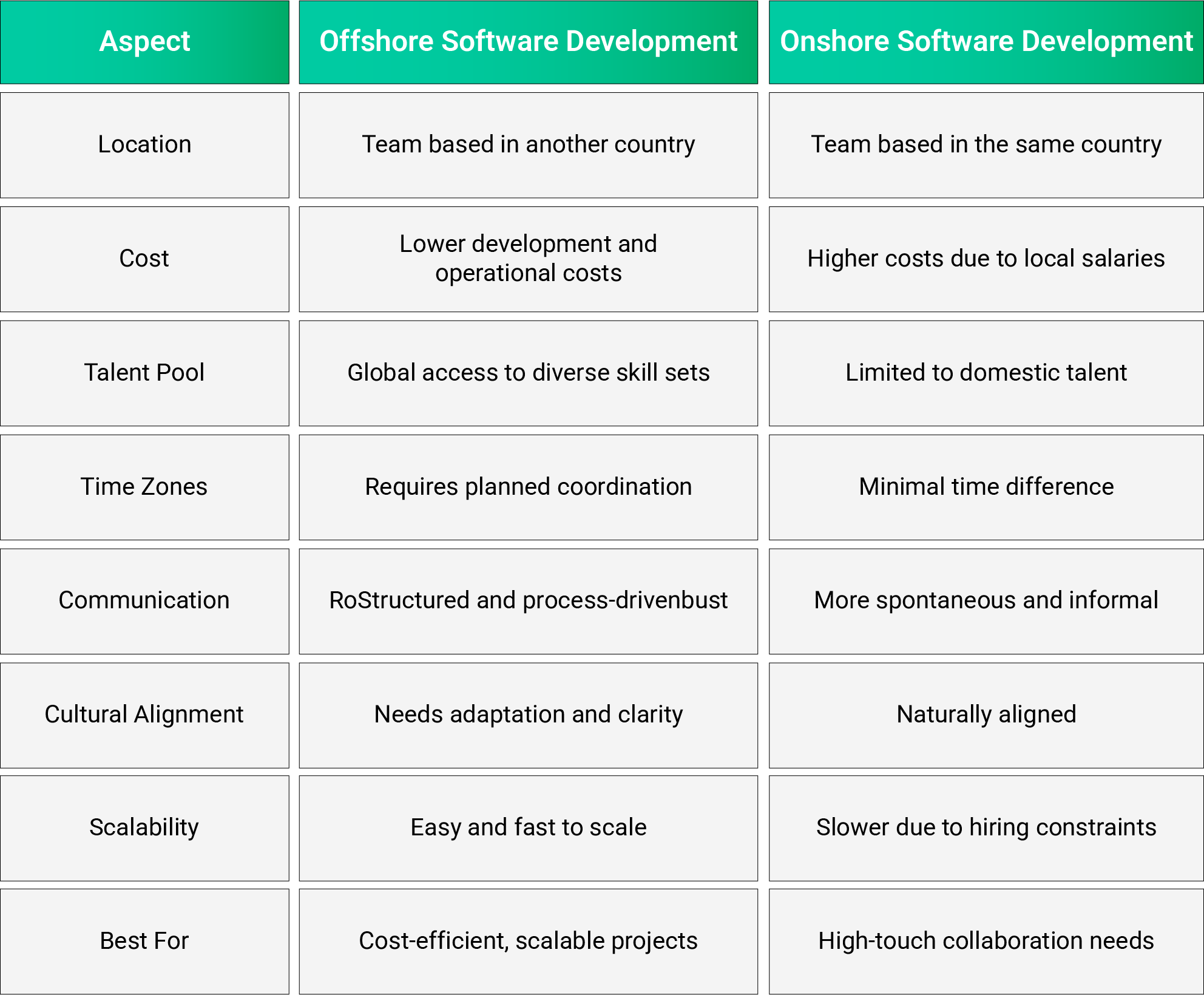
The right choice depends on whether your priority is budget optimisation or close, in-person
collaboration.
Benefits of Offshore Software Development
Cost Optimisation Without Quality Loss
Offshore development allows businesses to reduce costs while still accessing experienced engineers. When processes and quality standards are clearly defined, output quality remains high. Savings often come from lower labour costs rather than reduced capability.
Access to a Global Talent Pool
Offshore models open access to specialists in areas such as cloud architecture, data engineering, AI, and modern frameworks — skills that may be difficult or expensive to source locally.
Faster Time-to-Market
With distributed teams, development can continue across time zones. While one team finishes its workday, another can continue progress, shortening delivery cycles.
Scalability & Flexibility
Offshore teams can be scaled up or down based on demand. This flexibility helps businesses manage risk, especially during growth phases or uncertain market conditions.
Offshore Engagement Models
Dedicated Team Model
A long-term arrangement where a team works exclusively on your products. Best for continuous development and evolving requirements.
Fixed Price Model
Suitable for clearly defined projects with stable requirements. Cost and timeline are agreed upfront.
Time & Material Model
Ideal when requirements may change. You pay for actual effort spent, offering flexibility and transparency.
Offshore Development Centre (ODC)
A strategic setup where a full offshore team operates as a remote branch of your organisation, often following your internal processes and governance.
Challenges in Offshore Software Development (and Solutions)
Communication & Time Zone Gaps
Distance can slow decision-making if communication is not planned properly. Overlapping working hours, regular updates, and clear escalation paths help address this.
Data Security Concerns
Handling sensitive data offshore requires strong contracts, access controls, and security standards. Businesses should insist on clear compliance practices and regular audits.
Quality Control
Without strong governance, quality may suffer. Clear acceptance criteria, automated testing, and regular reviews ensure consistent delivery.
Cultural Differences
Different work cultures can lead to misunderstandings. Setting expectations early and maintaining clear documentation reduces friction.
IS Offshore Software Development Right for Your Business?
Startups & SMEs
Offshore development helps smaller businesses access experienced teams without committing to large internal headcounts.
Enterprises
Large organisations use offshore teams to extend capacity, modernise systems, and manage cost pressures at scale.
Long-Term Digital Roadmaps
If your business has a multi-year technology roadmap, offshore development provides flexibility to adapt and grow without constant restructuring.
Innovation-Driven Businesses
Offshore teams often bring exposure to varied industries and technologies, which can spark innovation and new approaches.
Quick Takeaways
- Offshore software development supports scalable, cost-effective growth.
- Clear processes are more important than physical proximity.
- Multiple engagement models suit different business needs.
- Challenges are manageable with the right governance.
- Strategic alignment matters more than short-term savings.
Conclusion
Offshore software development is no longer a shortcut — it is a legitimate, strategic delivery model for businesses that want to scale intelligently. When aligned with clear objectives, robust governance, and the right partner, offshore development can deliver high-quality outcomes while maintaining cost control.
For business owners, the real decision is not whether offshore development works, but whether it fits your operating style, risk tolerance, and long-term goals. With the right planning, offshore software development can become a dependable pillar of your digital strategy rather than a tactical experiment.
Frequently Asked Questions
What is offshore in the IT industry?
It refers to outsourcing IT or software work to teams located in another country.
Is offshore software development cost-effective?
Yes, when managed well, it reduces costs without sacrificing quality.
How do offshore teams communicate effectively?
Through structured processes, regular meetings, and collaboration tools.
Which industries commonly use offshore development?
Technology, finance, healthcare, retail, and enterprise services.
How do I choose an offshore software development company?
Look for proven experience, clear communication practices, security standards, and transparency.