
Table of Contents
- 1. Why 2026 Is the Year the Stack Stops Growing and Starts Delivering
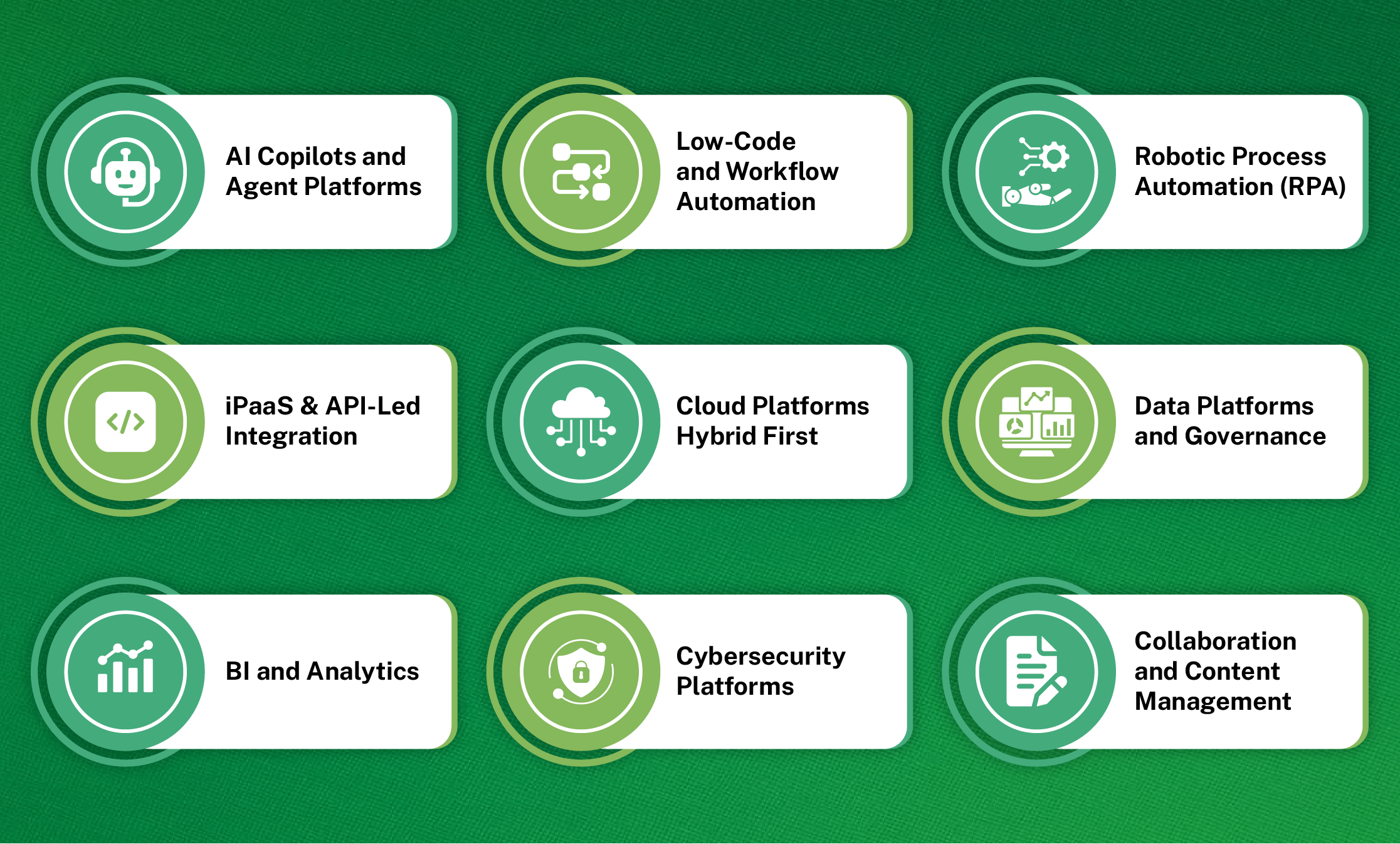
- 2. The 2026 Digital Transformation Stack at a Glance
- 3. Breaking Down the 9 Essential Categories.
- 4. How to Choose Your Starting Point.
- 5.Three Pitfalls That Derail Digital Transformation in 2026.
- 6. Frequently Asked Questions
- 8. Conclusion
Why 2026 Is the Year the Stack Stops Growing and Starts Delivering
Let’s be direct: most organisations that struggled with digital transformation over the past three years didn’t fail because they lacked ambition. They failed because they chased every shiny new platform instead of choosing the right few and making them work together.
2026 is different. Deloitte’s latest technology outlook frames this as the year businesses move from AI experimentation to enterprise impact. That shift changes everything including which digital transformation tools actually deserve a place in your budget.
What you need is a “short stack” — a lean, integrated set of tools spanning AI, automation, integration, data, security, and collaboration. When these layers work together, transformation compounds. When they don’t, you just accumulate expensive software licenses.
This guide walks you through the essential categories, the standout tools inside each, and the questions you should ask before committing to any of them.
The 2026 Digital Transformation Stack at a Glance
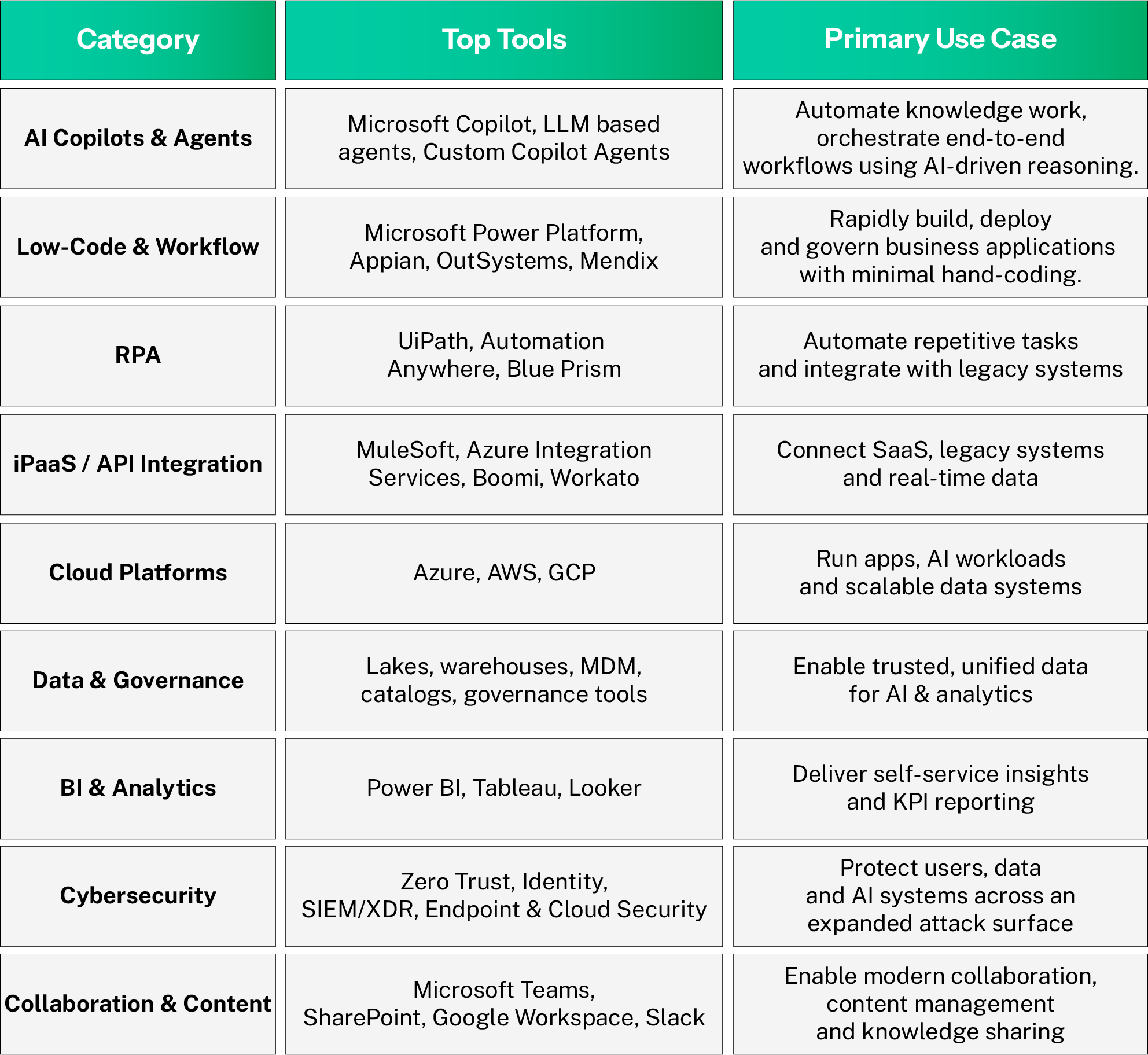
Breaking Down the 9 Essential Categories.
1. AI Copilots and Agent Platforms
If you only read one section, read this one. AI copilots have graduated from novelty to necessity. Microsoft Copilot, embedded across M365, Teams, and Dynamics 365, is the most widely deployed example but the real conversation in 2026 is about agents: AI systems that don’t just assist a human, they take action on behalf of one.
Organisations are now deploying agents that schedule meetings, process invoices, triage customer support queues, and generate first drafts of proposals all without a human in the loop for each step. The productivity gains are real, but so is the governance challenge. Before you roll out agents broadly, you need clear policies on what they can and cannot do autonomously.
Key question: Which high-volume, rules-based decisions in your business could an AI agent handle today if it had access to the right systems?
2. Low-Code and Workflow Automation
Microsoft Power Platform – Power Apps, Power Automate, Power Pages remains the dominant low-code ecosystem for enterprise teams. Its tight integration with M365 and Dynamics means your citizen developers are building on the same data layer as your ERP. Appian competes effectively in regulated industries where audit trails and compliance reporting matter as much as speed.
The critical success factor here is not the tool. It’s governance. Low-code sprawl is a real phenomenon: dozens of flows and apps built by well-meaning employees that break when someone leaves or a system changes. Invest in a Centre of Excellence before you scale.
3. Robotic Process Automation (RPA)
RPA isn’t going anywhere especially for companies that still run legacy systems that lack modern APIs. UiPath and Automation Anywhere are the market leaders, and both have invested heavily in combining RPA with AI (what they call “agentic automation”). Blue Prism continues to serve large regulated enterprises, while Power Automate Desktop offers a lower-cost entry point for Microsoft shops.
In 2026, the ROI from RPA is highest when you target processes that are high-volume, rule-based, and currently require humans to copy data between systems. If that description fits half your finance team’s day, RPA should be a priority.
4. iPaaS and API-Led Integration
No automation or AI initiative succeeds on bad plumbing. MuleSoft’s Anypoint Platform and Azure Integration Services are the gold standard for connecting disparate systems – SaaS, on-premises, partner APIs into a coherent data fabric.
The shift toward API-led connectivity means your integration layer becomes a reusable asset rather than a one-off project. When your CRM, ERP, HR system, and data warehouse all speak the same integration language, every new automation you build costs a fraction of the first one.
5. Cloud Platforms — Hybrid First
Azure, AWS, and GCP are no longer just “where you run servers.” In 2026 they’re the substrate for AI workloads, data platforms, and secure remote access. The hybrid-ready dimension matters more than ever: most enterprises cannot move everything to the public cloud for regulatory, latency, or cost reasons. The platforms that handle hybrid gracefully Azure Arc, AWS Outposts, Google Distributed Cloud give you flexibility without forcing a false choice.
Cost governance is the underrated skill here. Cloud spend without FinOps discipline can eclipse the savings it was supposed to generate. Build your governance muscle early.
6. Data Platforms and Governance
AI is only as trustworthy as the data it runs on. A modern data stack in 2026 typically combines a cloud data warehouse (Snowflake, Microsoft Fabric, BigQuery, or Redshift) with a data catalog for discoverability and master data management (MDM) for consistency. Without these, your AI models will confidently produce wrong answers because they were trained or queried against inconsistent records.
Data quality is not a technical problem – it’s an organisational one. The organisations that get this right assign data ownership to business domains, not just to IT.
7. BI and Analytics
Power BI and Tableau remain the tools of choice for making data visible and actionable. The 2026 differentiator is not the visualisation – it’s the embedding. The best deployments put the right metric in front of the right person in the context where they make decisions: inside Teams, inside their CRM, inside the morning briefing digest generated by an AI copilot.
Self-serve analytics only works when the underlying data is clean (see above) and when users are trained. Both conditions are more common than they used to be, but neither should be assumed.
8. Cybersecurity Platforms
Every digital transformation initiative expands your attack surface. AI copilots with access to sensitive documents, RPA bots with privileged credentials, cloud workloads accessible via API each is a potential vector. In 2026, the security architecture that maps to this reality is zero-trust: assume breach, verify explicitly, limit blast radius.
Practically, this means investing in identity platforms (Microsoft Entra, Okta), endpoint detection and response, and a SIEM or XDR solution that can correlate signals across your hybrid environment. Security is not a phase of the project. It’s a continuous capability.
9. Collaboration and Content Management
Microsoft Teams and SharePoint are the connective tissue of the modern digital workplace. They’re not glamorous, but they’re where most knowledge work happens and where AI copilots deliver value at scale. SharePoint as a knowledge base, Teams as the collaboration layer, and Copilot as the intelligence layer on top is a combination that most Microsoft-aligned organisations already have access to and are systematically underusing.
Change management, not technology, is the limiting factor here. The organisations that get the most from these platforms invest in training, champions networks, and clear use-case playbooks.
How to Choose Your Starting Point.
With nine categories in front of you, the temptation is to build a roadmap that covers all of them simultaneously. Resist it. Transformation compounds when you pick a function, go deep, and use that success to fund the next initiative.
Here are the most common starting points by business function in 2026:
Finance: High-volume, rule-based processes (invoice processing, reconciliation, reporting) make this the easiest place to demonstrate RPA and automation ROI quickly.
Sales and Marketing Ops: AI copilots for content creation, lead scoring, and CRM hygiene deliver visible results in weeks, not quarters.
HR: Onboarding workflows, policy Q&A bots, and skills data management are natural early wins for low-code and AI.
IT Service Management: AI-assisted triage, automated ticket routing, and self-service portals reduce ticket volume while improving employee experience.
Project Delivery: Workflow automation and BI integration give programme offices real-time visibility without manual status reporting.
Three Pitfalls That Derail Digital Transformation in 2026.
1. Tool Proliferation Without Integration
Buying tools is easy. Making them share data and workflows is hard. Before adding anything to your stack, map the integration points. If a new tool creates more data silos than it eliminates, it’s working against you.
2. AI Without Data Readiness
Deploying a copilot on top of inconsistent, duplicated, or ungoverned data produces confident-sounding wrong answers. Data maturity is a prerequisite for AI value, not an afterthought.
3. Technology Without Change Management
The most common cause of failed transformation is not a bad tool choice — it’s adoption failure. Users who don’t understand why the change is happening, or who weren’t involved in shaping it, will find workarounds. Invest in communication, training, and executive sponsorship before you invest in software.
Frequently Asked Questions
What is a digital transformation tool?
A digital transformation tool is any technology platform that helps an organisation replace manual, paper-based, or legacy processes with automated, data-driven, and digitally connected workflows. The most effective tools in 2026 span AI, automation, integration, cloud, data, security, and collaboration.
Which digital transformation tools are most important in 2026?
The nine categories that matter most are: AI copilots and agent platforms, low-code and workflow automation, RPA, iPaaS and API integration, cloud platforms, data governance, BI and analytics, cybersecurity, and collaboration tools. The specific products within each category matter less than how well they integrate with each other.
How do I start a digital transformation programme?
Choose one business function, identify two or three high-impact processes, and build a small cross-functional team. Deliver a measurable result within 90 days, then use that success as the foundation for the next initiative. Transformation is sequential, not simultaneous.
Is AI the most important digital transformation tool right now?
AI is transformative, but it depends on the layers beneath it. Without clean data, secure infrastructure, and integrated systems, AI copilots and agents underperform or produce unreliable outputs. Think of AI as the layer that amplifies value from the rest of your stack — not as a shortcut that replaces it.
Conclusion
Digital transformation in 2026 is not about buying more technology. It’s about making the right technology work together. The nine categories outlined above represent the minimum viable stack for an enterprise that wants to compete in an AI-enabled economy.
Start with the function where the pain is highest and the data is cleanest. Build integration discipline early. Take security seriously from day one. And treat change management as a delivery workstream, not a communications task.
The organisations pulling ahead right now aren’t the ones with the biggest technology budgets. They’re the ones with the clearest strategy, the most disciplined governance, and the most committed leadership. The tools are the easy part.