Table of Contents
- 1. Introduction
- 2. What is the Salesforce Customer Experience and Why Does It Matter?
- 3. Key Components of a Strong Salesforce Customer
- 4. Building a CRM Customer Experience Strategy With Salesforce
- 5. How Salesforce Uses AI to Elevate Customer Experience
- 6. Improving Service Quality With Salesforce Service Cloud
- 7. Conclusion
- 8. Frequently Asked Questions
Customer experience has become one of the few advantages that is difficult for competitors to copy.
1. Products can be matched.
2. Pricing can be undercut.
3. Features can be replicated.
2. Pricing can be undercut.
3. Features can be replicated.
But a customer’s feeling of being understood, supported, and valued is earned over time, and it is shaped by thousands of small moments rather than one big “wow” event.
That is why the Salesforce customer experience matters to business owners and decision makers.
Salesforce is often described as a CRM, but in practice, it acts as an operating layer for customer relationships: it stores context, coordinates handoffs, triggers follow-ups, enforces service standards, and helps teams make better decisions with shared visibility.
When Salesforce is implemented with customer experience in mind, it reduces friction in the customer journey and improves the consistency of how your business shows up across sales, onboarding, service, and renewals.
This article explains how to build a strong Salesforce customer experience using a practical, business-first approach.
You will learn what CX means in Salesforce terms, how to build a measurable engagement strategy, how to connect teams around lifecycle stages, how to use AI responsibly, and how Service Cloud can improve service quality without increasing operational cost.
Throughout, the focus stays on outcomes that leadership cares about: retention, speed, reliability, customer trust, and scalable growth.
What is the Salesforce Customer Experience and Why Does It Matter?
Definition of Salesforce Customer Experience
The Salesforce customer experience is the full impression customers form through every interaction that is created, managed, or influenced through Salesforce. It includes the obvious interactions like support tickets and sales calls, but it also includes the subtle ones: how quickly a case is acknowledged, whether customers are asked to repeat information, how consistent communication feels between teams, and whether follow-ups happen when they should.
In a practical sense, Salesforce customer experience is not a single cloud or feature.
It is the combined result of three things working together.
First, the quality and completeness of customer context in Salesforce.
Second, the workflows that govern how teams respond, escalate, and follow through.
Third, the discipline of adoption, meaning whether the organization actually uses Salesforce as the source of truth instead of running relationships through side conversations and personal spreadsheets.
How Salesforce Supports Customer Journey Mapping
A strong customer experience starts with clarity on the journey you want to deliver.
Customer journey mapping is the process of defining the stages customers pass through and identifying where friction, confusion, or drop-off tends to occur.
Salesforce supports this by allowing you to capture the lifecycle in structured stages, link touchpoints to specific moments, and measure journey performance using operational and customer-facing metrics.
Defining the Customer Journey with Clear Stages
Customer experience improves when the journey is clearly defined, not assumed.
Customer journey mapping breaks the lifecycle into explicit stages and makes expectations visible at every step.Salesforce supports this by structuring each phase as a trackable, owned stage rather than an abstract idea.
Connecting Touchpoints to Real Customer Moments
Journeys fail when touchpoints exist without context.
Salesforce links interactions, tasks, and communications directly to specific moments in the customer lifecycle. This creates a shared understanding of what the customer experiences, not just what internal teams deliver.
Identifying and Closing the Handoff Gaps
One of the most common breakdowns happens between sales closure and onboarding.
If ownership, expectations, or next steps are unclear, customers feel dropped at a critical moment. Salesforce removes this gap by enforcing standardized handoff steps, clear ownership, and automated task triggers.
Turning Journey Mapping into an Operating Model
Journey mapping only creates value when it moves beyond workshops and slides.
Salesforce operationalizes the journey through automation, visibility, and measurable outcomes.
The result is a living system where teams act on the journey every day, not just design it once.
The Business Impact of Salesforce CX Optimization
Salesforce CX optimization has a direct effect on outcomes leadership tracks.
It reduces service cost by removing avoidable work, such as duplicated case handling or manual routing.
1. It improves retention by lowering the everyday friction that pushes customers away.
2. It increases expansion opportunities because satisfied customers are more open to deeper adoption.
3. It improves internal productivity because teams spend less time searching for context and more time solving problems.
2. It increases expansion opportunities because satisfied customers are more open to deeper adoption.
3. It improves internal productivity because teams spend less time searching for context and more time solving problems.
Most importantly, it improves reliability. In many industries, reliability is the fastest path to trust.
A customer who experiences consistent follow-through is far more likely to renew than a customer who has to chase updates, even if the final outcome is technically “resolved” in both cases.
Why Customer Experience is a Competitive Advantage Now
The modern buyer has more options and less patience for unnecessary effort.
They expect speed, clarity, and continuity as baseline behavior, not as premium service.
Businesses that can deliver a consistent, low-friction experience at scale win more renewals, generate more referrals, and face fewer escalations.
Salesforce helps you compete on this dimension because it enables consistency.
It reduces dependency on individual heroics and replaces it with repeatable systems.
That shift is what transforms customer experience from a slogan into an operational advantage.
Key Components of a Strong Salesforce Customer
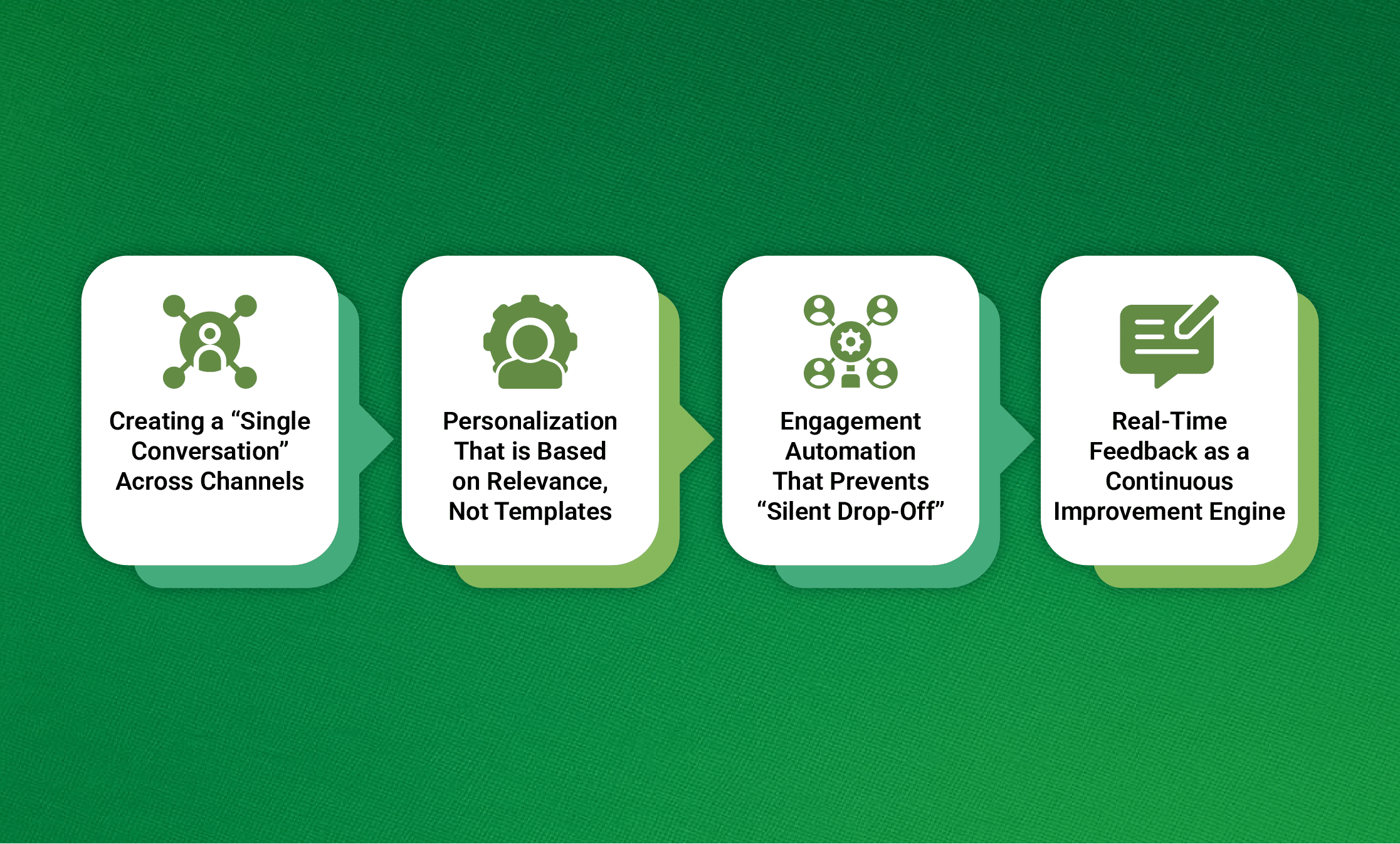
Creating a “Single Conversation” Across Channels
Customers may start in email, continue through phone, and expect updates via messaging.
They do not treat these as separate conversations. A strong Salesforce customer engagement strategy is built around maintaining that continuity inside Salesforce so customers are not forced to restart from the beginning at every interaction.
Personalization That is Based on Relevance, Not Templates
Personalized customer interactions are often misunderstood as surface-level customization.
Real personalization is relevance: speaking to what the customer is actually trying to achieve and responding to what has already happened. Salesforce enables this through unified customer context, where service history, product ownership, engagement activity, and relationship notes can be used to guide the next interaction.
Engagement Automation That Prevents “Silent Drop-Off”
Many customer relationships do not fail because of a major mistake. They fail because follow-ups do not happen and customers gradually disengage. Salesforce prevents this when engagement is supported by automated workflows such as reminders, next-step task creation, structured escalations, and consistent post-resolution follow-ups. This is where sales automation workflows and process automation become a CX tool rather than just an internal efficiency tool.
Real-Time Feedback as a Continuous Improvement Engine
Customer feedback is valuable only when it leads to action. Salesforce can capture feedback signals, such as customer satisfaction surveys after case resolution and connect them to categories, journey stages, and service teams. This allows leadership to identify patterns rather than treating feedback as isolated incidents.
Building a CRM Customer Experience Strategy With Salesforce
Aligning CX With Business Outcomes
A CRM customer experience strategy should start with outcomes that decision makers care about. Common outcomes include reducing churn during the first 90 days, improving time-to-first-response, increasing renewals, and reducing cost-to-serve.
Once these outcomes are defined, Salesforce becomes the mechanism to translate them into structured workflows, automation rules, and measurable performance indicators.
Building a Roadmap for Digital Transformation With Salesforce
Digital transformation with Salesforce is most effective when it is delivered in phases.
A phased approach lowers risk, increases adoption, and produces measurable wins early.
A strong roadmap typically starts with customer data structure, standard definitions, and essential workflows, then expands into omnichannel communication, analytics, and AI-driven insights.
Creating Operational Alignment Across Sales, Service, and Marketing
Customers experience your business as one entity, not as departments. Therefore, your Salesforce implementation must support shared lifecycle definitions, shared ownership rules, and consistent handoff standards between teams.
A practical way to achieve this is to standardize lifecycle stages and clearly define what each stage means.
1. When an opportunity closes, what must be recorded for service to deliver onboarding correctly?
2. When a customer raises repeated issues, how does that impact marketing messaging or account management?
3. When renewals are approaching, what signals indicate risk, and what playbook should activate?
2. When a customer raises repeated issues, how does that impact marketing messaging or account management?
3. When renewals are approaching, what signals indicate risk, and what playbook should activate?
This alignment is one of the fastest ways to improve the Salesforce customer experience because it reduces contradictions and prevents customers from receiving mixed messages.
Measuring CX Strategy Success Using a Focused Metric Set
Metrics should support decisions, not create noise. For customer experience, a focused set of metrics is typically more effective than dozens of dashboards. Customer satisfaction metrics, time-to-first-response, time-to-resolution, escalation rate, and reopen rate are common operational indicators. Retention and renewal rates show whether experience improvements are translating into business outcomes.
If leadership reviews the same metrics monthly and assigns clear ownership for improvement actions, Salesforce becomes a system of continuous optimization rather than a static database.
How Salesforce Uses AI to Elevate Customer Experience
AI as a Practical Support Layer, Not a Replacement for Strategy
AI improves customer experience when it supports better decisions and faster service, not when it is introduced as a shortcut to avoid fixing foundational issues. In Salesforce, AI is most valuable when it helps identify risk early, prioritize work intelligently, and provide suggestions that save time while maintaining quality.
This is where AI-driven customer insights become meaningful. Instead of simply showing data, AI can help teams interpret patterns and respond proactively. However, AI performs best when the underlying data is accurate and the processes are consistent.Without those foundations, AI tends to amplify inconsistency rather than solve it.
Predictive Signals That Help Teams Act Earlier
Predictive capabilities can help identify customers who are likely to churn, cases that are likely to escalate, or accounts that show signs of declining engagement. When used correctly, these signals allow teams to intervene earlier, at a stage when the customer is still open to resolution and trust rebuilding is easier.
This improves the Salesforce customer experience because it shifts service from reactive to preventive. Customers feel that the organization is paying attention and addressing issues before they become painful.
Recommendations That Improve Speed and Consistency
AI-generated recommendations can help guide next steps, suggest relevant knowledge content for agents, and support consistent service quality. The value is in reducing variation in service delivery so customers receive reliable answers regardless of which person handles the interaction.
When recommendations are paired with clear governance and human judgment, they increase speed without reducing personalization.
Improving Service Quality With Salesforce Service Cloud
Building Reliable Case Handling Without Service Chaos
Service Cloud becomes a customer experience asset when case handling is structured and predictable. Clear categorization, priority rules based on impact or customer tier, and smart routing ensure issues reach the right teams quickly, leading to faster responses and fewer escalations through consistent service behavior. Consistency signals professionalism. Customers may accept delays, but uncertainty weakens trust. A strong Service Cloud setup reduces that uncertainty by keeping communication timely and resolution steps visible.
Knowledge and Self-Service That Reduces Customer Effort
Self-service is not about deflecting customers but about reducing effort through fast, accurate guidance. A strong knowledge base combined with a well-designed self-service portal helps customers resolve common issues quickly while freeing service teams to focus on complex problems. This improves service quality by reducing backlogs, increasing first-contact resolution, and driving higher satisfaction through faster outcomes. When knowledge is treated as a living asset and updated from real cases, the customer experience improves continuously rather than declining over time.
Field Service Experiences That Protect Trust in On-Site Operations
For businesses delivering on-site service, the field experience is often the most emotionally important part of the relationship. Customers value reliability, professionalism, clear communication, and first-visit resolution. Salesforce field workflows support this through disciplined scheduling, technician readiness, and clear updates on timing and outcomes. When field service is coordinated through Salesforce, missed appointments reduce, communication improves, and resolution quality becomes consistent, strengthening customer trust.
Analytics That Turns Service Performance Into CX Improvement
Service analytics becomes valuable when it drives improvement actions. Tracking response and resolution times, backlog trends, reopen rates, and satisfaction helps leaders spot bottlenecks and service gaps before they become systemic. The most effective approach is to treat analytics as a management rhythm. Regular reviews with clear ownership, actions, and follow-up create continuous improvement that customers experience over time.
Conclusion
A high-performing Salesforce customer experience is not created by installing tools and hoping culture fills the gaps. It is created by designing an intentional customer lifecycle, capturing reliable context, building workflows that prevent drop-offs, and measuring performance in a way that drives action. For decision makers, the value is straightforward: customers stay longer, service costs become more predictable, and growth becomes easier because relationships are built on trust rather than constant recovery.
If your organization wants to improve customer experience without turning Salesforce into a complex internal project, begin with one journey stage, typically onboarding or service resolution, and optimize it end-to-end. Once one stage becomes strong and repeatable, expansion to the rest of the lifecycle becomes faster, less risky, and far more sustainable.
Frequently Asked Questions
What is Salesforce customer experience?
Salesforce customer experience is the end-to-end experience customers have across interactions managed through Salesforce, including sales, onboarding, service, and renewals, driven by customer context, workflows, and consistent execution.
How does Salesforce improve customer engagement?
Salesforce improves customer engagement by enabling connected communication, relevant personalization, structured follow-ups, and automated workflows that prevent delays and missed handoffs across teams.
Why is a CRM customer experience strategy important for business growth?
A CRM customer experience strategy supports growth by improving retention, reducing service costs, increasing customer lifetime value, and creating consistent experiences that make renewals and expansions more likely.
What Salesforce tools help improve customer satisfaction?
Service Cloud, workflow automation, knowledge management, customer lifecycle reporting, and AI-driven insights contribute to improved customer satisfaction by increasing speed, consistency, and relevance.
How does AI improve customer experience in Salesforce?
AI improves customer experience by surfacing risk signals early, supporting prioritization, recommending consistent next steps, and helping teams act proactively instead of reacting after customer frustration builds.