Table of Contents
- 1. Quick Answer
- 2. What are AI Integration Services?
- 3. Why Enterprises Struggle With AI Implementation?
- 4. How AI Solutions for Enterprises Are Implemented?
- 5.How Is AI Integrated Into Existing Business Systems?
- 6.Technology Stack for Enterprise AI Integration
- 7.When Should a Company Invest in AI Integration Services?
- 8.How to Choose the Right AI Integration Partner?
- 8. Final Thoughts
- 9. Frequently Asked Questions
Quick Answer
AI integration services embed AI capabilities into existing enterprise systems such as ERP, CRM, data warehouses, and workflow platforms. They ensure secure data access, structured deployment, governance controls, and scalable production rollout. The objective is to move AI from pilot environments into operational business processes.
Many enterprises have already experimented with AI. They’ve run pilots, tested use cases, and seen promising early results.
The challenge usually begins when those experiments need to be implemented in existing business systems. Integrating AI with ERP platforms, CRM systems, data warehouses, and operational workflows is far more complex than building a standalone model.
AI delivers measurable value only when it becomes part of daily operations. That is exactly where AI integration services come in, embedding AI securely within the enterprise technology environment so it can operate reliably at scale.
What are AI Integration Services?
AI integration services focus on connecting AI models and tools with enterprise systems, data sources, and applications so they can function within existing technology environments.
These services also involve aligning data sources, establishing secure system connectivity, and defining architectures that allow AI models to run reliably in production environments. The goal is not experimentation but structured deployment supported by governance, monitoring, and performance management.
Why Enterprises Struggle With AI Implementation?
- PoC to Production Gap: Pilots often succeed in controlled settings, but production environments require stable data pipelines, monitoring, integration layers, and governance controls. Without these elements, AI remains isolated.
- Infrastructure Fragmentation: Enterprise data and applications are spread across multiple systems with inconsistent standards. This fragmentation slows integration and makes scaling more complex than expected.
- Legacy System Complexity: Older ERP and operational platforms were not designed for modern AI workloads. Limited APIs and rigid architectures create integration constraints.
- Security and Compliance Barriers: AI must align with privacy regulations, access controls, and audit requirements. Governance concerns frequently delay deployment approvals.
How AI Solutions for Enterprises Are Implemented?
Artificial Intelligence integration services follow a structured path that moves solutions from experimentation into controlled production environments.
- 1. Strategic Alignment: Define business use cases, assess data maturity, and evaluate system architecture before implementation begins.
- 2. Architecture Blueprint: Design integration layers, data flow, security boundaries, hosting strategy, and scalability framework.
- 3. Data and System Integration: Establish governed data pipelines, configure secure APIs, and enable middleware connectivity across ERP, CRM, and enterprise platforms.
- 4. Model Enablement: Integrate LLMs or AI models with enterprise data sources using controlled retrieval mechanisms and access controls.
- 5. Workflow Embedding: Embed AI outputs directly into approvals, service workflows, reporting systems, or operational triggers.
- 6. Production Deployment and Governance: Launch with monitoring, logging, lifecycle management, and compliance controls to ensure long-term stability.
How Is AI Integrated Into Existing Business Systems?
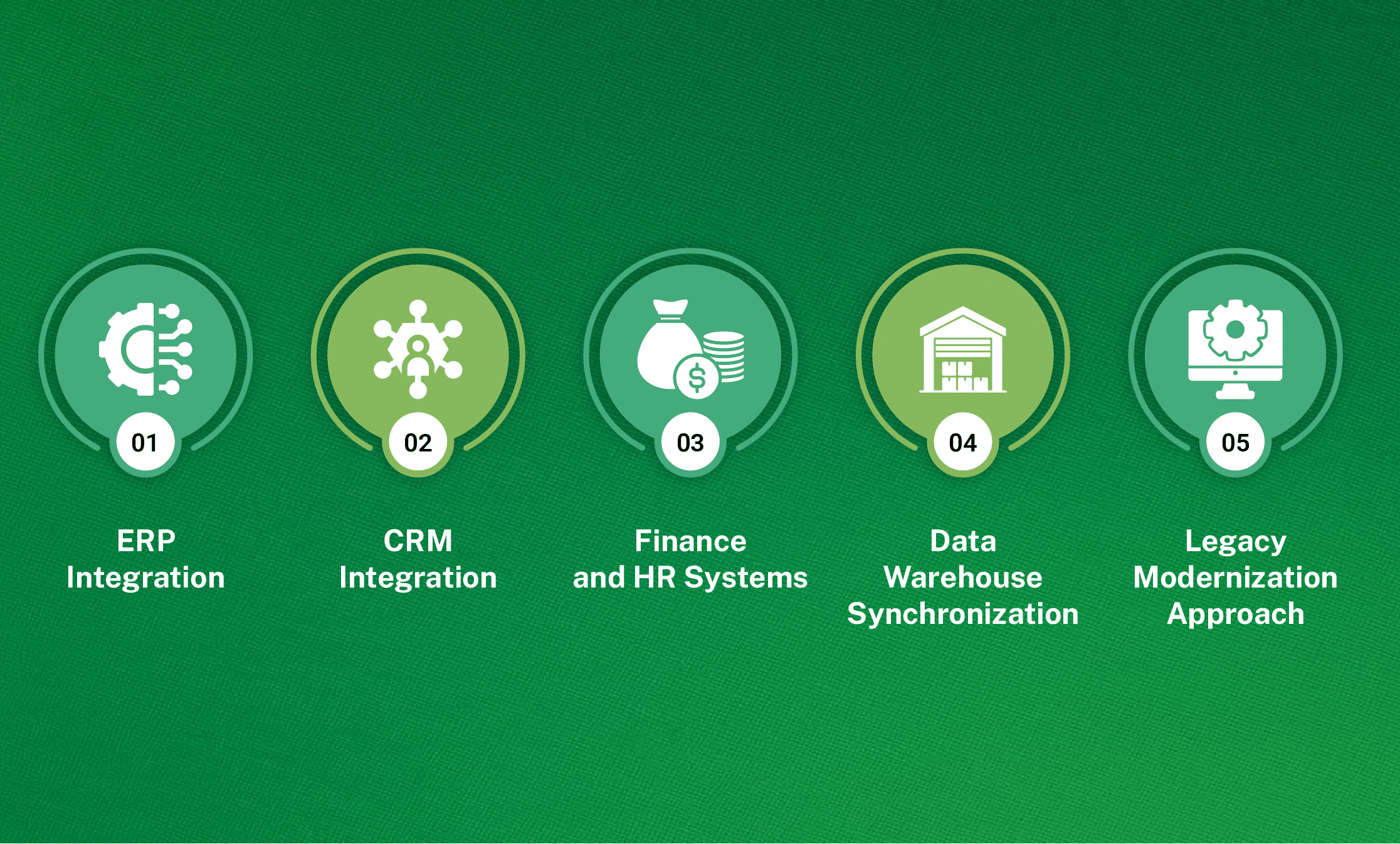
AI integration is not about replacing your existing systems. It’s about extending them so AI works inside the processes and data environments you already rely on.
ERP Integration
AI connects to ERP systems to access transactional data such as procurement, inventory, production, and finance records. Through secure APIs and middleware layers, it can analyze operational patterns, automate validation checks, and support decision workflows without disrupting core ERP functionality.
CRM Integration
Finance and HR Systems
AI integrates with finance and HR systems to support expense validation, payroll anomaly detection, workforce analytics, and compliance monitoring. Secure data access and role-based controls ensure that confidentiality and regulatory alignment are maintained.
Data Warehouse Synchronization
AI systems often rely on centralized data repositories. Integration ensures data warehouses or lakes are synchronized so models receive consistent, validated inputs and reporting remains accurate.
Legacy Modernization Approach
For older systems with limited API support, integration may involve middleware, data replication layers, or phased modernization strategies. The goal is to enable AI capabilities without forcing immediate system replacement, allowing business continuity while expanding functionality.
Technology Stack for Enterprise AI Integration
Enterprise AI integration depends on a stable and scalable technical foundation. The stack is not limited to models; it includes the infrastructure, governance, and orchestration layers that allow AI to function reliably in production.
- Cloud-Native Architecture: Cloud infrastructure provides scalability and distributed processing for AI workloads that require variable compute demand.
- MLOps Framework: MLOps ensures models are versioned, tested, monitored, and retrained in a controlled manner so performance does not degrade over time.
- Governance and Access Control: Role-based access, encryption, audit logging, and compliance controls protect enterprise data.
- Agent-Based Systems: AI agents enable automated decision execution within workflows, allowing AI to act within defined boundaries rather than operate as passive analytics.
- Orchestration Layers: Orchestration coordinates data movement, model execution, and system communication. This ensures AI processes integrate smoothly with business operations.
When Should a Company Invest in AI Integration Services?
Organizations should consider AI integration when experimentation alone is no longer sufficient and structured deployment becomes necessary.
After a Successful Pilot
If a proof of concept has delivered value but cannot scale across departments or systems, integration services help move it from isolated testing into production. At this stage, gaps in data readiness, connectivity, and governance usually become visible.
During Digital Transformation
When enterprises modernize infrastructure, migrate to cloud platforms, or redesign processes, it creates a practical opportunity to embed AI directly into the new architecture. Integrating at this stage reduces future rework and keeps the technology strategy aligned.
When Scaling AI Across Departments
As AI use cases expand beyond a single team, differences in data standards, security policies, and integration methods start to surface. A structured integration approach keeps performance and governance consistent across functions.
When Compliance Risks Increase
When AI begins processing financial, customer, or employee data, regulatory exposure increases. Integration services ensure access controls, audit mechanisms, and policy enforcement are clearly defined.
How to Choose the Right AI Integration Partner?
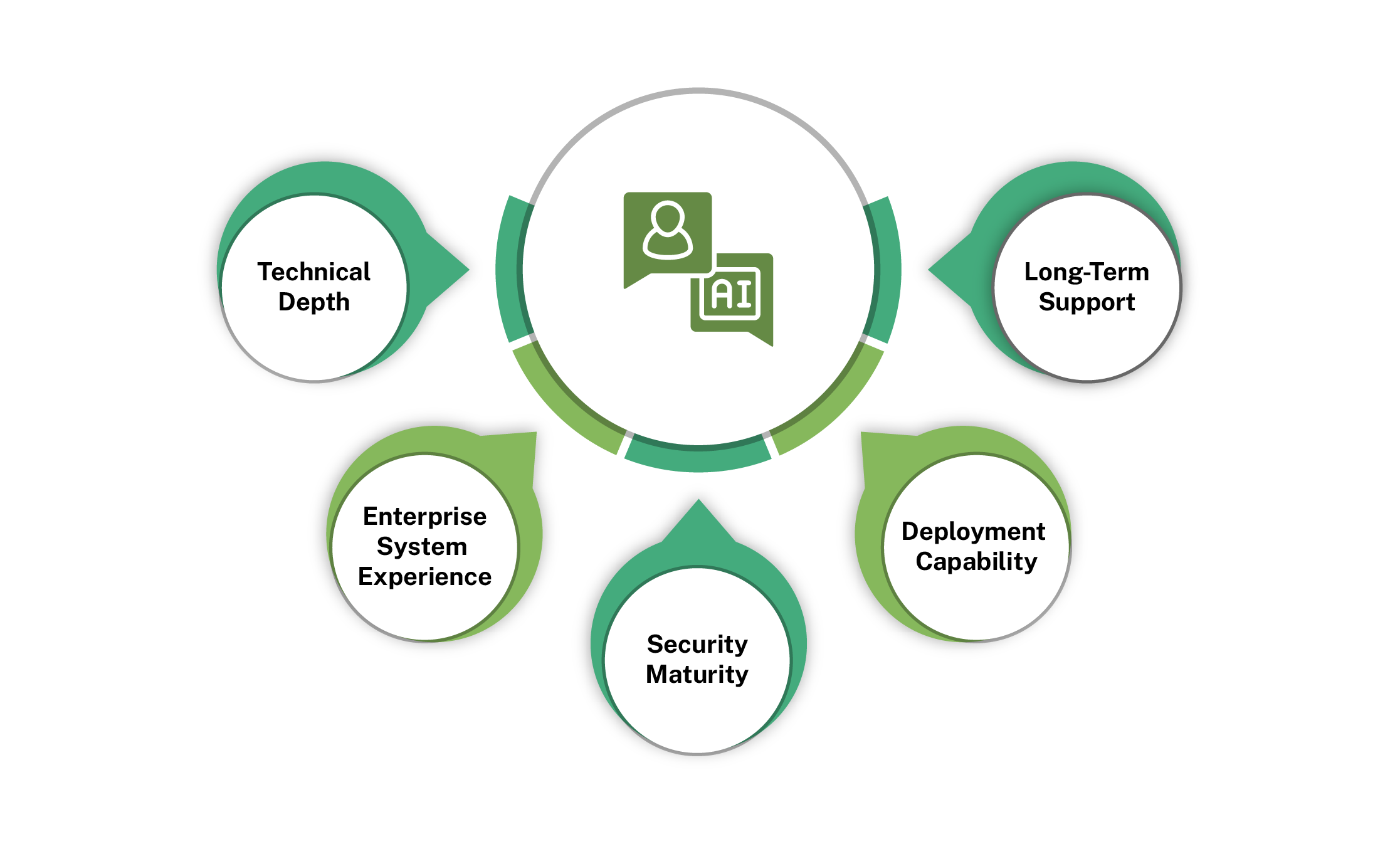
Choosing among AI integration companies requires more than reviewing capabilities on paper. The evaluation should focus on technical depth, enterprise system experience, governance maturity, and the ability to support long-term deployment.
Final Thoughts
AI adoption is increasing across enterprises, but measurable outcomes depend on structured integration inside existing business systems. When integration spans data pipelines, operational workflows, and governance controls, AI moves beyond isolated use cases and becomes part of daily execution.
Frequently Asked Questions
What are generative AI integration services?
Generative AI integration services embed large language models into enterprise systems to automate content generation, document analysis, and knowledge retrieval. They ensure secure data access, governance controls, and structured deployment within existing business workflows.
How are AI integration services for O365 implemented?
AI integration services for O365 are implemented by embedding AI capabilities into Microsoft 365 tools such as Teams, Outlook, and SharePoint. This enables intelligent search, document automation, and workflow assistance while maintaining tenant-level governance.
What makes SharePoint AI integration solutions effective?
SharePoint AI integration solutions are effective when AI is securely connected to document libraries and lists with structured metadata access. This enables intelligent search, summarization, and automation without compromising collaboration controls.
Are AI and GPT integration services suitable for regulated industries?
AI and GPT integration services can be deployed in regulated industries when proper governance, access controls, audit logging, and data isolation mechanisms are implemented. Integration frameworks ensure language models operate within defined compliance and security boundaries.