
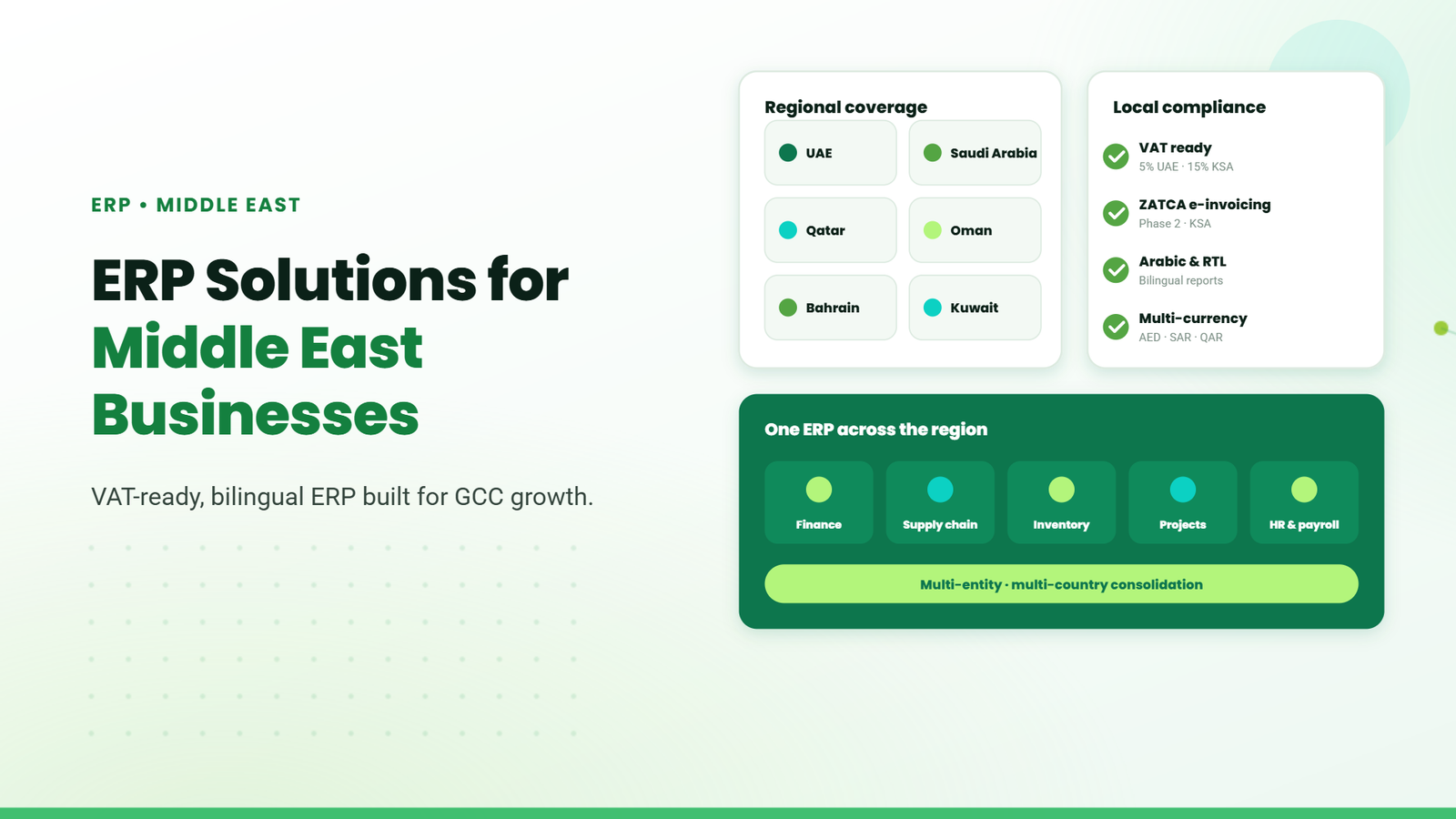
As businesses across the Middle East continue investing in digital transformation, ERP systems have become a key part of improving operational efficiency, financial visibility, and business growth. Whether you’re replacing disconnected software or moving away from manual processes, choosing the right ERP solution requires more than comparing features.
If you’re evaluating ERP solutions in the Middle East, it’s important to understand the different deployment options, implementation considerations, costs, and the factors that influence long-term success.
Why Businesses in the Middle East Are Investing in ERP in 2026
ERP adoption continues to grow as organizations look for better ways to manage finance, operations, inventory, procurement, sales, and customer information from a single platform.
Some of the key drivers include:

Business Growth
As organizations expand across locations or countries, managing separate systems becomes increasingly difficult. An ERP provides a centralized platform for managing business operations.
Improved Visibility
Real-time reporting allows decision-makers to monitor financial performance, inventory levels, purchasing, and operational activities without relying on multiple spreadsheets.
Process Automation
ERP software automates repetitive tasks such as approvals, invoicing, purchasing, inventory updates, and financial reporting, reducing manual effort and improving accuracy.
Supporting Digital Transformation
For many organizations, ERP forms the foundation of broader digital transformation initiatives by connecting people, processes, and business data across departments.
What Does an ERP System Include?
Modern ERP software brings together multiple business functions within a single platform.
Typical ERP modules include:
Financial Management
Manage essential finance and operations, including accounting, budgeting, accounts payable, accounts receivable, cash flow, and financial reporting from one system.
Inventory and Warehouse Management
Track inventory movements, stock availability, purchasing, warehouse operations, and order fulfillment in real time.
Sales and Customer Management
Manage quotations, sales orders, customer information, invoicing, and payment tracking through integrated workflows.
Procurement
Streamline purchasing activities, supplier management, approvals, and procurement reporting.
Reporting and Business Intelligence
Generate dashboards and reports that provide visibility across finance, operations, sales, inventory, and purchasing.
Cost of ERP Software in the Middle East
ERP software costs in the Middle East vary based on business size, deployment model, implementation scope, and local requirements. Costs can also differ across markets such as the UAE, Saudi Arabia, and other GCC countries based on regulatory, localization, and business requirements.
Rather than looking at licensing alone, businesses should consider the total cost of implementation. Several factors influence the overall investment:
Number of Users
More users generally increase licensing costs, although pricing models differ between ERP vendors.
Business Complexity
Organizations with multiple locations, warehouses, legal entities, or specialized workflows typically require more implementation effort.
Customization Requirements
Standard ERP functionality may be sufficient for some businesses, while others require custom workflows, reports, or industry-specific features.
Integrations
Connecting ERP software with CRM systems, eCommerce platforms, payroll software, manufacturing systems, or business intelligence tools can increase implementation costs.
Training and Support
User training, post-go-live support, and ongoing optimization should also be included when budgeting for an ERP implementation.
Not Sure Which ERP Solution Fits Your Business?
From Microsoft Dynamics 365 Business Central to Finance & Operations, the right ERP platform depends on your organization’s size, processes, and operational needs. Explore how TechnoRUCS can help you identify a suitable ERP solution for your business.
Common ERP Implementation Challenges
Implementing an ERP requires careful planning to minimize disruption and maximize long-term value.
Some common challenges include:
Poor Data Quality
Migrating inaccurate or duplicate data can affect reporting, inventory accuracy, and financial records. Reviewing and cleaning data before migration helps reduce these risks.
Unclear Business Processes
Implementing technology without clearly defining business processes often leads to unnecessary customizations and inconsistent workflows.
User Adoption
Employees need adequate training and support to adopt new ways of working. Strong change management improves user confidence and encourages successful adoption.
Integration Complexity
Connecting an ERP with existing CRM, payroll, manufacturing, or eCommerce systems requires planning to ensure reliable data exchange across applications.
Choosing the Right ERP Deployment Model
Businesses can implement ERP in different ways depending on their operational and technical requirements.
| Deployment Model | Best For | Considerations |
|---|---|---|
| Cloud ERP | Businesses looking for flexibility and lower infrastructure costs | Subscription-based with automatic updates |
| On-Premises ERP | Organizations with specific infrastructure or compliance requirements | Greater control but higher infrastructure investment |
| Hybrid ERP | Businesses combining cloud and on-premises environments | Offers flexibility but requires careful integration planning |
Selecting the right deployment model helps balance cost, scalability, security, and long-term business requirements.
How to Choose the Right ERP Solution
Choosing an ERP is not just about comparing features. The right solution should align with your business processes, support future growth, and integrate with your existing technology landscape.
When evaluating ERP solutions, consider the following:

Industry Requirements
Different industries have different operational needs. A manufacturing business may prioritize production planning and shop floor management, while a retail business may focus on inventory, point-of-sale integration, and demand forecasting.
Scalability
Your ERP should be able to support additional users, locations, and business processes as your organization grows without requiring a complete system replacement.
Ease of Integration
Most businesses already use CRM, payroll, eCommerce, or business intelligence platforms. Choosing an ERP that integrates well with these systems helps create a connected business environment.
Vendor Support
Evaluate the implementation methodology, post-go-live support, training, and product roadmap before selecting an ERP vendor or implementation partner.
Table of Contents
Talk to our Microsoft Expert Consultant
Conclusion
Choosing the right ERP solutions in the Middle East is about more than software features or licensing costs. It requires understanding your business processes, growth plans, and operational requirements to select a platform that can support your organization over the long term.
Whether you’re modernizing legacy systems or investing in your first ERP, careful planning and the right implementation approach help maximize value while reducing project risks.
Planning your ERP implementation in the Middle East?
TechnoRUCS can help you evaluate the right ERP solution, plan the implementation, and align it with your business requirements and growth plans.
Share this article

About the Author
Chandru D is the CEO of TechnoRUCS, sharing insights on Microsoft technologies, Salesforce solutions, AI, and digital transformation to help businesses solve challenges and grow through technology.
Frequently Asked Questions
ERP solutions are integrated software platforms that help businesses manage finance, inventory, purchasing, sales, operations, reporting, and other core business processes from a single system.
Businesses are adopting cloud ERP solutions in the Middle East to support multi-location operations, improve access to business data, reduce infrastructure management, and scale more easily as their operations grow.
The best ERP depends on your business size, industry, operational requirements, and growth plans. Cloud ERP solutions are often a popular choice for growing small businesses.
The ERP implementation timeline depends on business size, project complexity, customization, and integration requirements. Smaller implementations may take a few months, while larger, multi-department deployments typically require more time.
Accounting software focuses on financial management, while ERP systems integrate finance with inventory, sales, purchasing, operations, reporting, and other business functions.
ERP integration with existing systems connects ERP software with CRM, payroll, eCommerce, manufacturing, and business intelligence platforms, allowing data to move between applications and reducing manual data entry.
An ERP vendor comparison should look at industry fit, features, scalability, integration capabilities, implementation support, pricing, and ongoing service to determine which vendor best meets your business requirements.