
Table of Contents
- 1. Quick Answer
- 2. What are AI Solutions for Enterprises?
- 3. Why Enterprises Use AI?
- 4.How AI Solutions for Enterprises Are Implemented?
- 5.Where Enterprise AI Solutions Are Used Across the Organization
- 6.Benefits of AI Solutions for Enterprises
- 7.Limitations of Enterprise AI Solutions
- 8. Conclusion
- 9. Frequently Asked Questions
Quick Answer
AI solutions for enterprises are systems that apply artificial intelligence within business workflows across departments such as sales, finance, HR, operations, and IT. These solutions are integrated with enterprise systems like CRM and ERP to automate repetitive tasks, improve decision accuracy, and handle large volumes of data. Their impact depends on how well they are implemented within specific processes rather than as standalone tools.
Managing work across multiple systems and departments is a constant challenge in enterprises.
As volume increases, tasks like cross-system integration, repetitive data entry, manual data checks, and correcting error-prone processes start consuming more time and effort than expected.
AI solutions for enterprises are increasingly used to support these workflows by reducing manual effort, saving time across operational cycles, and improving execution across departments.
However, the impact of AI depends heavily on where and how it is applied within the organization. This blog explains how AI solutions are used in enterprises across departments, how they are implemented, and their benefits and limitations.
What are AI Solutions for Enterprises?
Enterprise AI solutions are AI capabilities applied directly within business workflows across an organization. They are integrated with existing systems such as CRM, ERP, finance, HR, and support platforms, and operate as part of normal business execution.
These solutions are used in areas where volume, repetition, and data complexity make manual handling inefficient. They are commonly applied to tasks such as classification, analysis, prioritization, and decision support, enabling departments to operate with greater consistency and accuracy.
Why Enterprises Use AI?
How AI Solutions for Enterprises Are Implemented?
Identifying the Right Processes
Enterprise AI implementation usually begins with processes that already handle high volumes of work, such as approvals, reporting, or request handling. These workflows follow clear steps, repeat frequently, and produce measurable outcomes.
Applying AI to Specific Workflow Steps
AI is not applied to the entire process at once. It is introduced at specific points where manual effort is high or decisions are repetitive. This includes steps like classification, prioritization, validation, recommendation, or exception flagging.
Using Data From Existing Enterprise Systems
Using AI Outputs in Workflows
AI outputs are placed directly inside the workflow where action is taken. This could be within dashboards, approval screens, work queues, or reports, allowing users to consume AI results without changing how they work.
Maintaining Human Review and Control
For workflows that involve financial impact, compliance, or operational risk, AI outputs are reviewed before execution. This keeps accountability with the business while still reducing manual workload.
Expanding Usage Gradually
Implementation usually begins with a limited scope. Once accuracy and impact are validated, AI usage is extended to similar workflows or additional departments, with continuous refinement based on usage patterns and results.
Where Enterprise AI Solutions Are Used Across the Organization
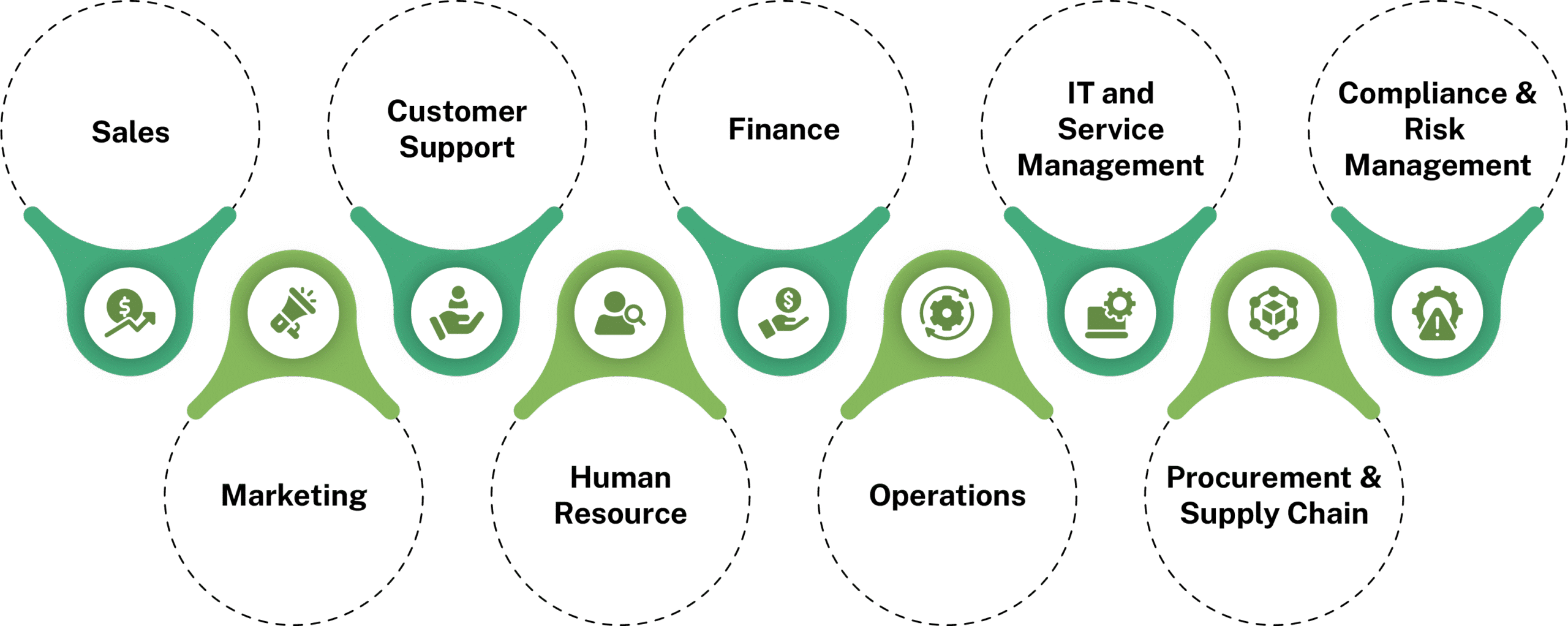
Enterprise AI solutions are used across multiple departments, with each function applying AI based on the type of work it handles and the outcomes it is responsible for.
Sales
In sales, AI is used to support pipeline management and deal execution. This includes lead prioritization, pipeline forecasting, and identifying deal risks early, allowing sales teams to focus on opportunities that are more likely to close.
Marketing
Marketing teams use AI to manage scale across campaigns and channels. AI supports audience segmentation, personalization, and performance analysis, helping teams understand what is working and where adjustments are needed.
Customer Support
In customer support, AI is applied to high-volume service workflows. Common use cases include ticket classification, routing, response assistance, and prioritization, helping reduce resolution time and improve consistency.
Human Resources
HR teams use AI in hiring and people operations. This includes candidate screening, workforce analysis, internal request handling, and employee support, especially where volume and repeatability are high.
Finance
Finance functions use AI for data-intensive work such as forecasting, anomaly detection, financial reconciliation, and expense analysis. AI helps improve accuracy, speed up reviews, and surface issues earlier in the reporting cycle.
Operations
Operations teams apply AI to improve process flow across systems. AI is used to identify inefficiencies, optimize workflows, and coordinate activities that span multiple tools and teams.
IT and Service Management
In IT and service management, AI supports incident detection, ticket analysis, and root cause identification. This helps reduce repetitive support work and improves response to recurring issues.
Procurement and Supply Chain
AI is used in planning-heavy areas such as demand forecasting, vendor evaluation, and inventory management. These use cases help improve planning accuracy and reduce operational risk.
Compliance and Risk Management
AI is used to support regulatory checks, policy validation, and risk assessment processes. Common applications include reviewing contracts and documents for compliance gaps, monitoring transactions or activities against defined rules, and preparing inputs for audits and regulatory reporting.
This helps reduce manual review effort and improves consistency in how compliance and risk-related work is handled across the organization.
Benefits of AI Solutions for Enterprises
Reduced Manual Effort
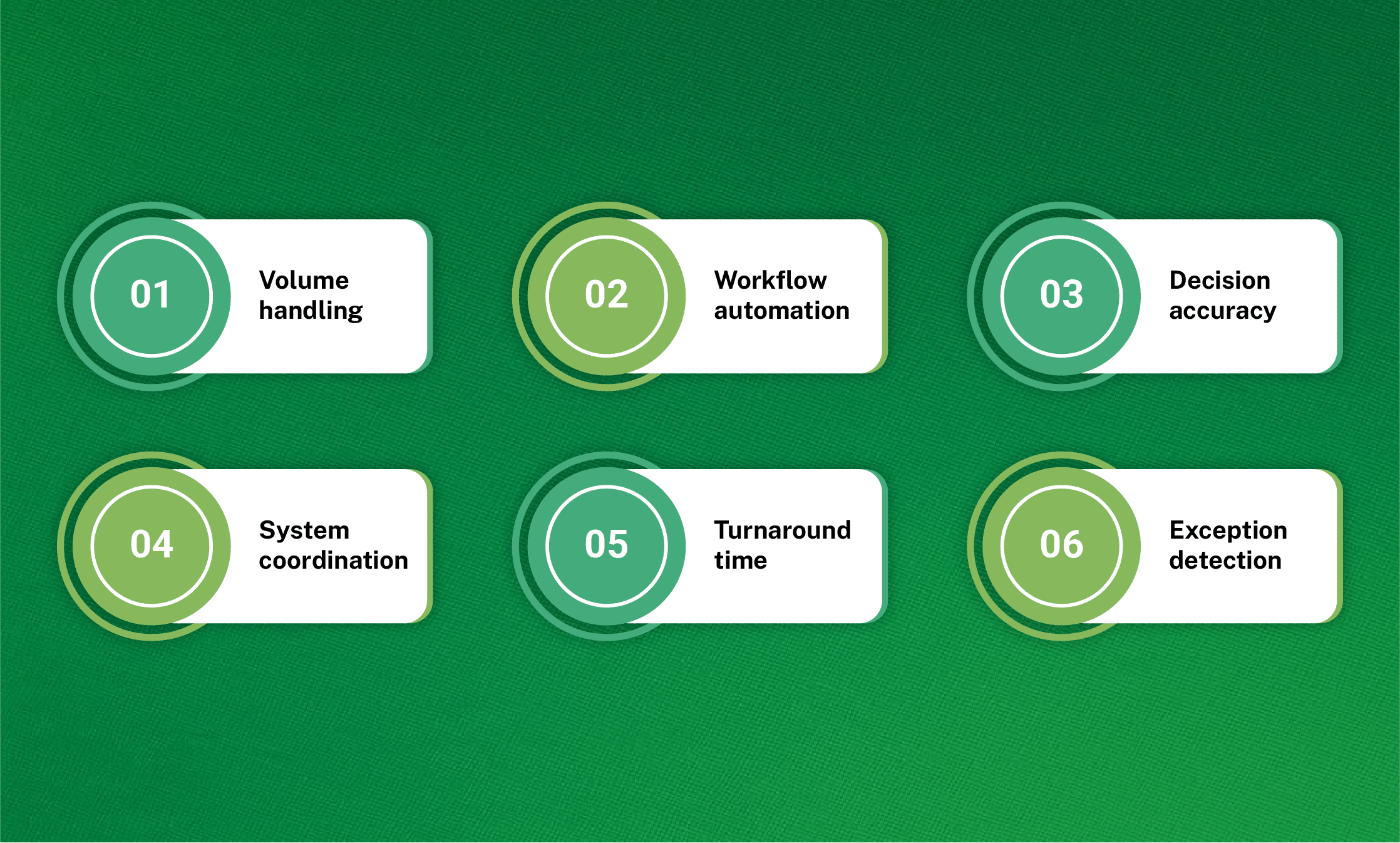
Enterprise AI automation solutions reduce the amount of time spent on repetitive tasks such as data entry, validation, classification, and routing. This allows teams to spend less time maintaining processes and more time acting on outcomes.
Faster Turnaround Times
By automating steps that typically depend on manual reviews, follow-ups, or handoffs, AI shortens approval cycles, reporting timelines, and response times across departments.
Improved Decision Quality
AI supports decisions by analyzing historical data and current inputs consistently. This improves the accuracy of forecasts, prioritization, and recommendations compared to purely manual judgment.
Better Handling of Scale
As transaction volume, requests, or records increase, AI enables processes to scale without proportionally increasing operational effort. This helps maintain performance during growth or peak periods.
Earlier Detection of Issues
AI can surface anomalies, errors, or exceptions while processes are still in progress, instead of after reporting or closure. This allows corrective action to happen sooner.
Consistent Execution
By applying the same logic and rules across workflows, AI helps ensure processes are handled consistently, regardless of department, location, or workload.
Limitations of Enterprise AI Solutions
- Data dependency: AI outputs depend on the quality and consistency of data from existing systems
- Process suitability: Limited effectiveness in workflows that are unstructured or heavily subjective
- Human oversight: Review is still required for decisions involving financial, legal, or operational risk
- Integration effort: Implementation requires effort to connect multiple enterprise systems
- Cost considerations: Initial implementation, licensing, infrastructure, and ongoing optimization can require significant investment.
- Ongoing maintenance: Updates are required when data patterns or business rules change
Conclusion
AI solutions for enterprises are most effective when applied to specific departmental workflows rather than treated as standalone initiatives. Different functions use AI in different ways, based on the work they handle and the decisions they are responsible for.
Applying enterprise AI at the department level keeps attention on actual execution and outcomes, making its role in everyday business operations clear.
Frequently Asked Questions
What are AI platforms for enterprises?
AI platforms for enterprises provide shared infrastructure to build, deploy, and manage AI across departments. They integrate with existing systems, handle data securely, and allow multiple teams to use AI consistently without building separate solutions.
How does intelligent automation help enterprises?
Intelligent automation combines rules, workflows, and AI to reduce manual effort in repeatable processes. It is commonly used for approvals, data validation, routing, and exception handling, helping enterprises improve speed and consistency without redesigning existing operations.
How are machine learning solutions used in enterprise AI?
Machine learning solutions are used where patterns, predictions, or classifications are needed at scale. In enterprises, they support forecasting, risk detection, prioritization, and recommendations by learning from historical data and improving accuracy over time.